

Published on
AI coding assistants like GitHub Copilot, Claude, and Codex are rapidly becoming part of everyday development. They accelerate delivery, reduce toil, and help teams move faster than ever.
But there’s a growing problem hiding behind that productivity boost: AI assistants routinely generate insecure code, and most teams are relying on guardrails that simply weren’t designed to keep up.
Aspen: Guardian AI was built to solve that gap.
The Problem: Productivity Without Context Creates Risk
AI assistants are trained broadly. Your application is not.
Today’s common approaches like static prompt files, generic secure coding rules, or post-generation scanning, fall short because they:
- Don’t understand your specific languages, frameworks, or patterns
- Don’t adapt as your codebase evolves
- Repeatedly flag the same issues after the fact
The result is a frustrating loop: AI suggests insecure code, scanners catch it, and developers fix it… and the AI makes the same mistake again tomorrow.
The Idea: Teach the AI Using Your Real Security Findings
Aspen: Guardian AI closes the loop.
Instead of relying on static rules or generic safety guidance, Guardian learns directly from your existing CI security scans. It takes real vulnerabilities found in your project and converts them into tailored instructions for your AI coding assistant.
Those instructions live where developers already expect them. Files like:
- copilot-instructions.md
- CLAUDE.md
- .cursor/rules.md
As your codebase and development practices change, Guardian keeps those rules up to date.
How Aspen: Guardian AI Works
At a high level, Guardian fits naturally into modern DevSecOps pipelines: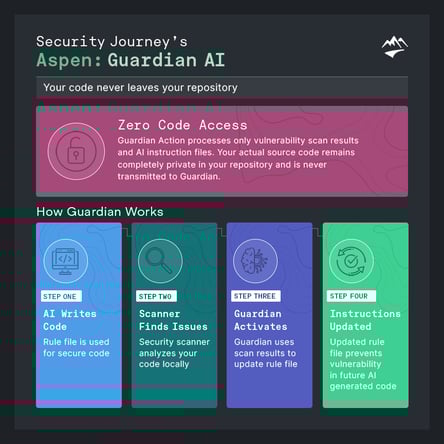
- Your security scanner runs as usual
Tools like Bandit, Snyk, Semgrep, and others analyze your code locally in CI. - Guardian ingests scanner findings
Guardian processes the scan results to identify recurring and potentially critical
issues. - Findings become AI guidance
Those issues are transformed into clear, project-specific rules your AI assistant
can use to avoid introducing similar vulnerabilities in the future. - Rules are updated via pull request
Guardian proposes updates to your AI instruction file through a PR, giving teams
full visibility and control.
Developers can review, modify, and approve every change, without blocking builds or slowing delivery.
A Feedback Loop That Improves Over Time
The real power of Aspen: Guardian AI is the feedback loop it creates:
- AI generates code
- Scanners flag a vulnerability
- Guardian updates AI rules
- AI becomes less likely to repeat the mistake
Instead of endlessly fixing the same issues, teams gradually shape the behavior of their AI assistant to match their project’s real security expectations.
The AI doesn’t just generate code faster; it generates better code over time.
Privacy by Design: Your Code Never Leaves Your Repo
AI tooling often raises valid concerns about data exposure and code privacy. Guardian was designed to address those concerns directly. Guardian never reads or transmits your source code.
What Guardian processes:
- Vulnerability scan results (JSON)
- Your AI instruction file
- Scanner metadata (tool type)
What Guardian never accesses:
- Application source code
- Repository contents or history
- Credentials or secrets
Your code stays exactly where it belongs: in your repository. Guardian learns only from scanner findings, not from your proprietary logic.
How Guardian Compares to Other Approaches
Many tools in the market focus on:
- Measuring how insecure AI-generated code is
- Fixing vulnerabilities after detection
- Applying generic safety guardrails to AI systems
Aspen: Guardian AI takes a different approach:
- Operates at the project level, not a generic model level
- Uses real vulnerabilities, not theoretical risks
- Creates a living security policy that evolves with your codebase
- Improves AI behavior without adding friction for developers
Why This Matters for Modern Teams
As AI becomes a permanent part of software development, security teams face a choice:
- Keep reacting to AI-generated vulnerabilities
- Or teach AI assistants how to avoid them
Aspen: Guardian AI enables the second path, turning reactive scanner findings into proactive security guidance.
“Most tools tell you what the AI did wrong. Aspen: Guardian AI teaches the AI not
to do it again.”
A Smarter Way to Secure AI-Assisted Development
Aspen: Guardian AI doesn’t replace scanners, developer judgment, or secure coding training. It amplifies them, making every scan an opportunity to improve future AI-generated code.
The result is faster development, fewer repeat vulnerabilities, and AI assistants that adapt alongside your codebase.
That’s what it means to build secure software in the age of AI.